Human civilization has been on a path of rapid progress since the agricultural revolution, and today, agriculture is about to be transformed by the AI revolution. Artificial Intelligence can propel crop yields to their maximum level and address supply chain issues that weren’t possible before.
While there are several benefits of AI in agriculture, food security in the face of climate change is the most important one. As the global population keeps growing and climate change threatens food security, AI can be the perfect tool for optimizing all the resources we have.
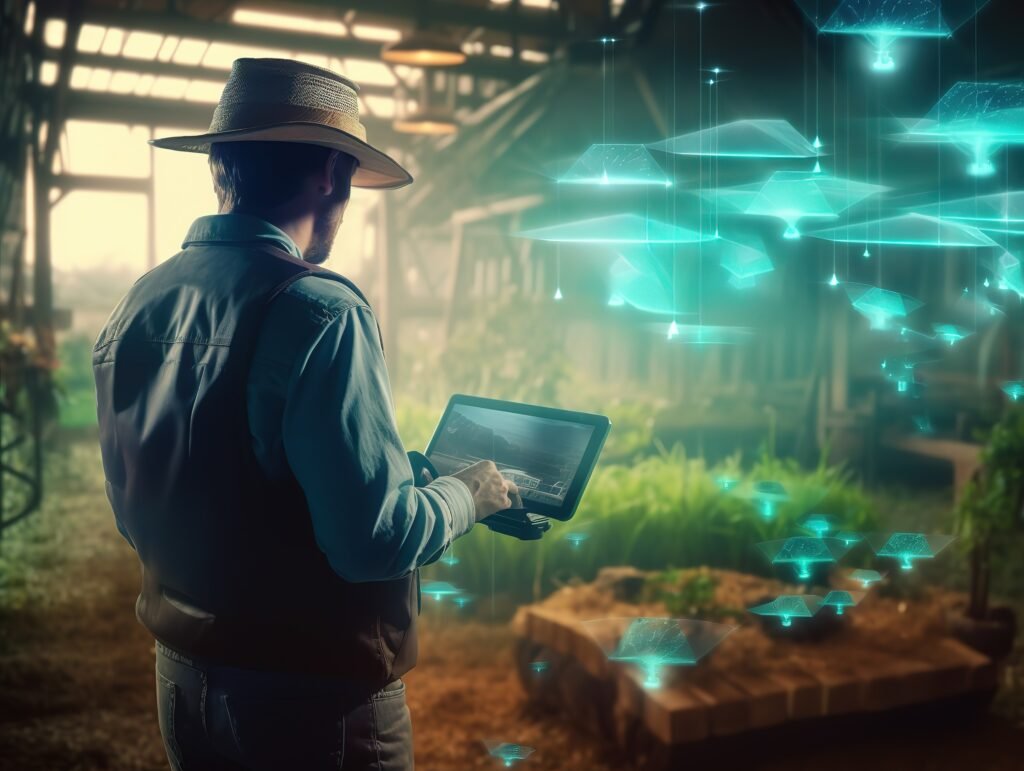
Intuition and experience have always been the foundation of farming. However, AI applications in agriculture can bring valuable data points that assist in that experience and build on that intuition.
From crop health to moisture levels and live weather changes, everything can be accounted for. With sensors spread across crop fields, AI can use data collected by them to deliver useful insights. Those insights may help farmers to:
Farming has faced disruptions since it was invented. With every innovation that threatens to displace farmers, they are constantly fighting an uphill battle. Modern farming technology with AI integration can change that for the better. Farmers can use drones with high-resolution cameras and AI-powered image recognition, and combine that with field sensor data. This enables them to identify infected crops or signs of an infestation early on.
That allows the average farmer to take quick action before the disease spreads and makes them lose their entire harvest. Moreover, artificial intelligence in agriculture can take several factors into account, including:
To suggest the right strategy for increasing crop yields. AI models can also predict crop yields and market forces to help farmers strategize for the future. Here’s a scenario- If a farmer in Iowa cultivates corn, harvest season can be stressful. It demands you to:
With AI-powered yield prediction, farmers have an easier time and higher profits.
The role of AI isn’t limited to the fields either. Artificial Intelligence in agriculture can also go a long way to fine-tune supply chains and analyze markets. For instance, tomatoes and grapes come with a short shelf life. If they need to travel from California to cities across the country, AI can analyze weather and traffic patterns to suggest the best routes for trucks and minimize waste.
Moreover, AI can also predict crop prices and show when they reach their peaks and bottom down. This helps farmers decide on the right time to sell their crops and reap a bountiful harvest, or store them and store them in their silos. So, it’s a win-win for both farmers and the planet as fewer resources get wasted. Similar to its role in cybersecurity, AI for sustainable agriculture can reduce or even eliminate risks in the agricultural industry.
Early detection and precise management of pests are crucial to prevent crop damage and minimize the use of chemical pesticides. Leveraging data from weather reports, historical pest patterns, and high-resolution images from drones or satellites, AI-powered systems can predict pest outbreaks and identify infestations.
By analyzing location and weather data, these systems can forecast the potential impact of pests and send targeted alerts to farmers via mobile apps. This enables farmers to take prompt, targeted action, reducing crop losses and chemical application.
With the help of computer vision, drones and robots can precisely identify and remove weeds, preventing them from competing with crops for resources. This targeted approach enables farmers to control weeds mechanically or apply herbicides precisely, reducing waste and environmental impact.
From optimizing supply chains to helping farmers with data-driven insights, the future impact of AI on agriculture is undeniable. It helps farmers take several steps at a time in the right direction and ensure food security for a rapidly changing world.

As a tech-savvy Digital Marketing Specialist at Digital Concepts for the past five years, Sushmita Banerjee bridges the gap between complex tech and impactful storytelling. She channels her expertise into writing thought-provoking content covering everything from AI and software to the latest gadgets and breakthrough tech trends.