Imagine spending weeks climbing the ranked ladder in your favorite shooter, only to lose because someone is using an aimbot that never misses. It’s frustrating, unfair, and enough to make many players quit.
Whether you’re grinding in Counter-Strike 2, dropping into Call of Duty: Warzone, or building your Valorant rank, cheating has become one of the biggest threats to competitive gaming. As online tournaments, esports prize pools, and ranked matchmaking continue to grow, so does the sophistication of cheat developers.
That’s exactly why AI anti-cheat for gaming is becoming the industry’s newest weapon. Instead of simply searching for known cheat files, AI studies how players behave, spots suspicious patterns, and learns to detect new forms of cheating that traditional systems might miss. It’s a smarter and more adaptive approach to keeping matches fair.
In this guide, you’ll learn how AI-powered anti-cheat works, why game developers are investing heavily in it, and what it means for both casual and competitive players.
Competitive gaming isn’t just about bragging rights anymore. Today, millions of players compete for rankings, streaming audiences, sponsorships, and even careers. According to Newzoo, the global gaming audience has grown to well over 3 billion players, making online multiplayer games bigger than ever. With so much at stake, cheating has evolved into a thriving underground industry.
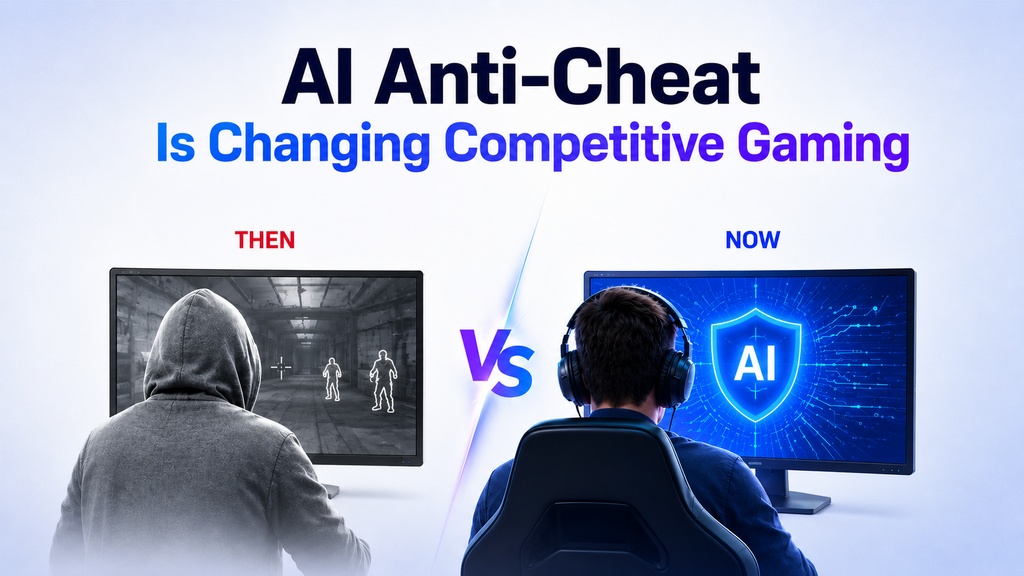
Years ago, most cheats were fairly simple. Players downloaded scripts that modified game files or injected code into the game process. Developers responded by updating their gaming anti-cheat software whenever new exploits appeared. It worked for a while, but cheat creators quickly adapted.
Today’s cheats are far more advanced.
Some use machine learning to create smarter aim assistance. Others rely on computer vision models that analyze what’s happening on screen instead of directly modifying game files. Since these tools often behave differently from traditional hacks, they can be much harder to detect using signature-based methods alone.
WIRED reports how the popularity of free cheat marketplaces and subscription-based cheating services has made the problem even worse. Some websites even offer customer support and regular software updates, operating much like legitimate SaaS companies.
A single tournament victory can be worth thousands (or even millions) of dollars. That creates a powerful incentive for bad actors to gain any advantage they can.
Manual moderation simply can’t keep up with millions of matches happening every day. Reviewing gameplay footage one report at a time would take an enormous workforce and still leave many cheaters undetected.
This growing challenge is forcing studios to rethink their entire approach to game security violation detection. This has led them toward AI that can monitor gameplay at a scale humans never could.
Pop culture has long warned us about technology being used for both good and bad. Just as Tony Stark keeps upgrading Iron Man’s suit whenever a stronger villain appears, game developers now have to constantly improve their defenses against increasingly intelligent cheats.
Traditional anti-cheat tools mainly look for known cheat signatures, suspicious software, or unauthorized modifications running on a player’s computer. While effective against familiar threats, they often struggle when entirely new cheating techniques appear.
AI anti-cheat changes the approach completely.
Instead of asking, “Is this a known cheat?” it asks, “Is this player behaving like a human?”
Modern AI anti-cheat software uses machine learning models trained on millions of gameplay events. These models learn what normal player behavior looks like across different skill levels. They examine factors such as movement, aiming, reaction speed, accuracy, positioning, and decision-making.
When a player’s actions consistently fall outside normal patterns, the system assigns a risk score. Rather than issuing an immediate ban, many developers combine AI findings with additional evidence before taking action. This helps reduce false positives while improving detection accuracy.
Unlike traditional detection systems that require frequent manual updates, AI models improve over time as they process more gameplay data. Every confirmed cheating incident helps the model recognise similar behavior faster in the future.
AI can monitor players regardless of whether they are using well-known cheats or newly developed exploits that have never been seen before.
Many developers now combine AI with traditional detection tools instead of replacing them entirely. Signature detection still blocks known cheats, while AI focuses on behavioral analysis that’s much harder to fool.
This layered strategy creates a much stronger defense than relying on either method alone.
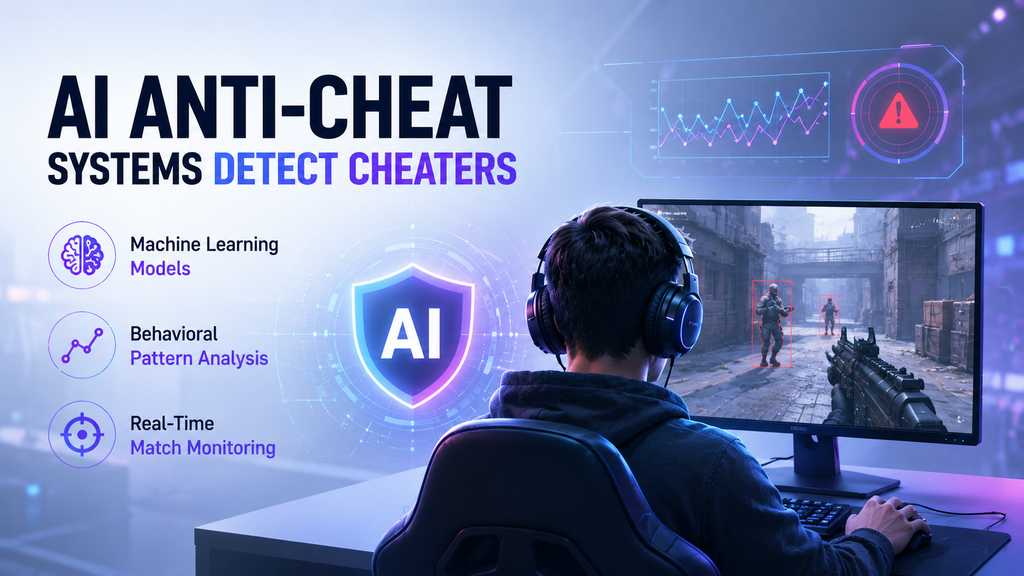
AI doesn’t need to “see” a cheat program running to identify suspicious activity. Instead, it studies how people play and compares that behavior against millions of previous matches.
Let’s look at how this works.
Think about watching a professional basketball player take free throws. Their movements are incredibly consistent, but they’re still human. Every shot has tiny differences. Cheaters often lack those natural variations.
AI models analyze hundreds of gameplay signals, including:
For example, an aimbot might snap perfectly to enemy heads with identical precision every single time. Even elite esports players don’t perform with robotic consistency across thousands of engagements.
As highlighted in ACM Digital Library anti-cheat studies, behavioral analysis focuses on these subtle differences instead of searching for cheat files. This makes detection significantly harder to bypass.
Machine learning is what gives AI its ability to improve over time.
Developers feed enormous datasets into training models containing examples of both legitimate gameplay and confirmed cheating. The system gradually learns which combination of actions indicates suspicious behavior.
Rather than relying on a single factor, AI looks at dozens (or hundreds) of variables simultaneously.
If you’re trying to identify a fake painting, for instance, you wouldn’t examine only the signature. You’d also inspect the brush strokes, color choices, materials, and overall technique. AI follows the same principle.
Every match becomes another learning opportunity, allowing detection accuracy to improve as more data becomes available.
Modern AI systems don’t always wait until a match ends. Many continuously monitor gameplay while the match is still in progress.
If unusual behavior appears repeatedly, the player can be flagged for additional review.
Some systems may temporarily increase monitoring intensity rather than immediately issue penalties. Others combine behavioral analysis with hardware information, account history, previous reports, and match statistics before making the final decision.
This layered approach helps developers maintain competitive integrity while avoiding unnecessary punishments for legitimate players.
You’ve probably heard debates about kernel-level anti-cheat (KLAC) on gaming forums or Reddit. The topic often sparks heated discussions because it operates at one of the deepest levels of a computer’s operating system. Alexandre Philbert, a software developer at the famous video game company EA, frames it as an imperfect but essential security measure for high-stakes competitive PC gaming.
Running at the kernel level allows anti-cheat systems to detect cheats that hide from normal software. This provides stronger protection against advanced exploits, but it also raises understandable concerns about privacy and system access.
For that reason, many developers now pair kernel-level monitoring with AI-driven behavioral analysis instead of relying on deep system access alone. The goal is to strengthen cheat detection while minimizing unnecessary data collection.
Finding the right balance between security and player privacy remains one of the industry’s biggest challenges.
| Feature | Traditional Anti-Cheat | AI Anti-Cheat |
| Detection method | Searches for known cheat signatures | Learns player behavior and identifies anomalies |
| New cheat detection | Limited until updated | Can identify previously unseen cheating patterns |
| Learning ability | Requires manual updates | Improves continuously using machine learning |
| Speed | Detects known threats quickly | Detects suspicious behavior in real time |
| Adaptability | Reactive | Proactive |
| Human review | Often required after detection | Frequently combined with AI risk scoring before action |
| Long-term effectiveness | Depends on frequent signature updates | Becomes more accurate as it processes additional gameplay data |
As cheating techniques become increasingly sophisticated, many developers now view AI as the next evolution of competitive game security rather than simply another detection tool.
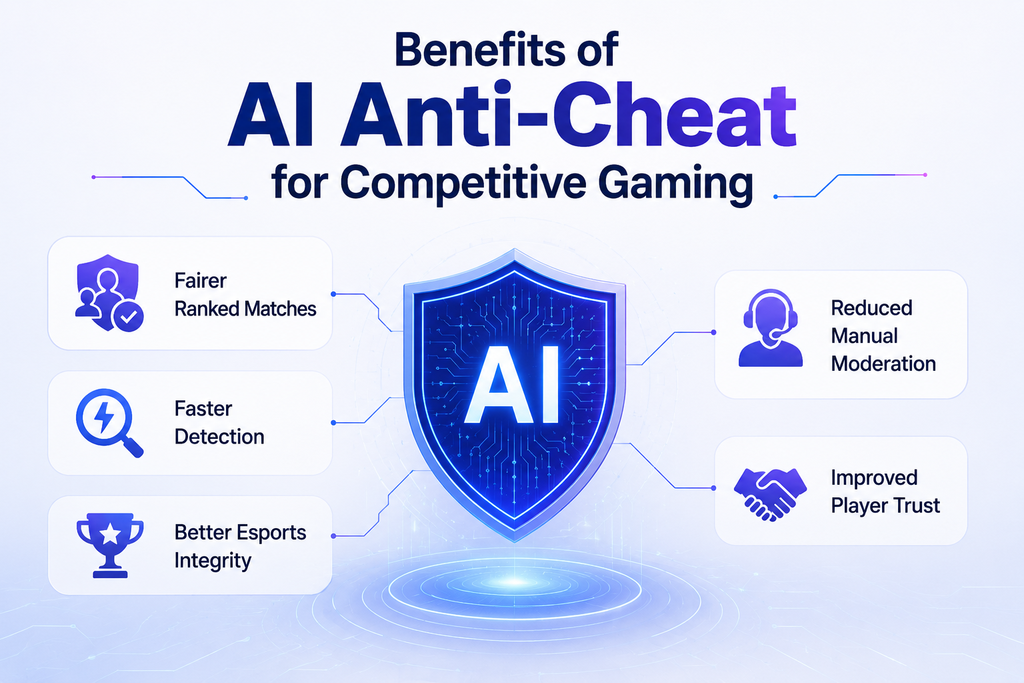
AI isn’t just making cheat detection smarter. It’s helping create a better experience for everyone involved, from casual gamers to professional esports athletes.
Nothing ruins a ranked session faster than losing to someone who clearly isn’t playing fair. AI reduces that frustration by identifying suspicious behavior much earlier than traditional methods.
Instead of waiting for thousands of player reports, modern gaming security software can recognize unusual gameplay patterns across multiple matches. That means fewer cheaters stay active for long periods and legitimate players spend more time competing on an even playing field.
Traditional anti-cheat tools often depend on updates before they can identify new cheats. AI doesn’t always need that waiting period.
Since it analyzes behavior rather than just software signatures, it can detect suspicious activity even when the cheating method hasn’t been documented before. This shortens the time between a cheat appearing and action being taken.
Esports has become a multi-billion-dollar industry, with tournaments offering life-changing prize pools. According to Esports Charts, major events regularly attract millions of concurrent viewers, making competitive integrity more important than ever.
AI helps tournament organizers identify unusual player behavior before it affects the credibility of an event. While human officials still make the final decisions, AI gives them better data to review.
Imagine reviewing gameplay reports from millions of matches every day. That’s simply impossible for human moderation teams.
AI filters massive amounts of gameplay data, allowing moderators to focus on the most suspicious cases instead of manually watching countless match replays.
Players are more likely to invest time in a game when they believe the competition is fair.
Whether you’re trying to hit Diamond rank or simply enjoy weekend matches with friends, knowing developers actively fight cheating builds confidence in the game’s long-term health.
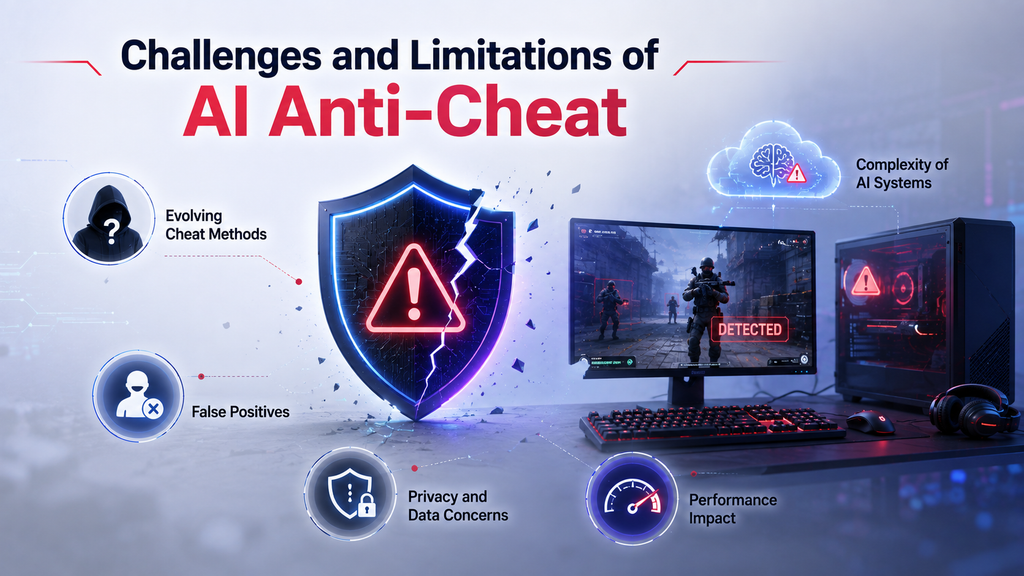
As impressive as AI is, it isn’t perfect.
Like Jarvis in the Marvel movies, AI can process huge amounts of information incredibly fast. But even Jarvis occasionally needed Tony Stark to make the final call. The same principle applies here.
No detection system is 100% accurate.
A professional player with exceptional aim or unusually fast reflexes could occasionally trigger automated alerts. That’s why most studios don’t rely entirely on AI when issuing permanent bans. Human review remains an important part of the process.
Many players worry about how much information anti-cheat systems collect.
Discussions become more heated when developers introduce kernel-level anti-cheat solutions, since these operate closer to the operating system.
Studios must balance stronger protection with transparent privacy policies that explain what data is collected and why.
Cheat developers aren’t standing still.
Some now use computer vision models that read gameplay directly from a monitor instead of modifying game files. Others build AI-assisted aim tools that intentionally include tiny imperfections to imitate human behavior.
This means anti-cheat developers must train their models to recognise evolving cheating techniques.
Building effective AI systems is expensive.
Developers need enormous datasets, powerful computing infrastructure, and teams of machine learning engineers to train and maintain these models. Large publishers can often afford this investment, but smaller studios may struggle to build similar systems.
Most leading multiplayer games now combine traditional security tools with advanced behavioral analysis. Here are a few examples.
Riot’s Vanguard system has become one of the most talked-about anti-cheat platforms in competitive gaming. It combines deep system monitoring with behavioral analysis to protect games like Valorant.
Rather than relying on one detection method, Riot continuously updates its models as cheating methods evolve.
If you’ve followed recent RICOCHET anti-cheat updates, you’ll know Activision has invested heavily in machine learning and server-side detection for Call of Duty.
According to Activision, Ricochet uses multiple detection techniques alongside ongoing data analysis to identify suspicious players and improve matchmaking quality.
Valve takes a slightly different approach. Its VAC (Valve Anti-Cheat) system historically relied on signature detection, while newer technologies such as VAC Live introduce faster responses to suspicious activity during live matches.
The company continues expanding its automated detection capabilities as competitive games evolve.
EA has increased its investment in fair-play initiatives across multiplayer titles, combining behavioral monitoring, player reporting, and automated detection systems to improve competitive integrity.
Ubisoft works with multiple security partners across games like Rainbow Six Siege, using layered detection strategies that include behavioral analytics and community reporting.
Although every publisher approaches anti-cheat differently, one trend is clear: AI has become a key part of modern competitive gaming.
Cheating has always been a game of cat and mouse. Every time developers strengthen their defenses, cheat creators search for new weaknesses. AI has accelerated this cycle.
Today, some cheat developers use machine learning to produce more human-like gameplay patterns. Others create software that intentionally misses occasional shots or delays reactions to avoid appearing robotic.
In response, AI anti-cheat systems continuously retrain themselves using newly collected gameplay data. It’s a bit like Batman facing the Joker. Every time Batman develops a new strategy, the Joker finds another unpredictable way to cause chaos.
Neither side stays still for long. The difference is that developers now have access to far more gameplay data than cheat creators, giving AI models a stronger foundation for identifying suspicious behavior over time.
As developers and cheat creators trade moves in real time, keeping up with the latest technology news is essential for understanding where online gaming is headed.
If you’re a legitimate player, AI anti-cheat is generally working in your favor. You don’t need to change how you play, but there are a few good habits worth following.
Remember, AI evaluates long-term gameplay patterns rather than isolated moments. Landing one incredible flick shot won’t get you banned. Consistently displaying impossible behavior over hundreds of matches is a very different story. For a complete walkthrough on protecting your accounts and system hardware, read our comprehensive gamer security guide.
The next generation of anti-cheat will likely become even smarter.
As cloud gaming, cross-platform play, and esports continue growing, anti-cheat technology will need to evolve alongside them.
We’re unlikely to see cheating disappear completely. But the gap between honest players and bad actors should continue shrinking as AI becomes more accurate and adaptive. For gamers, that’s good news. A fair match is always more satisfying than an easy win earned through unfair advantage.
For more insights on evolving AI systems and cybersecurity trends, check out our Technology News & Updates section. If you are an independent developer or researcher working on security solutions, visit our Tech: Write For Us page to share your insights with our community.
AI anti-cheat technology uses AI and machine learning to identify suspicious player behavior instead of relying only on known cheat signatures. It analyzes gameplay patterns such as aiming, movement, reaction times, and decision-making to detect cheating that traditional methods might miss. Since AI learns from large amounts of gameplay data, it can adapt to new cheating techniques over time and help maintain fair competition.
AI is making cheat detection more proactive and accurate. Instead of waiting for developers to update databases with newly discovered cheats, AI continuously monitors player behavior in real time and looks for unusual patterns. It can flag potential cheaters much faster, reduce the time cheats remain active, and assist human moderators by prioritizing suspicious cases for review.
Traditional anti-cheat software primarily detects known cheat programs by scanning for specific files, code signatures, or unauthorized modifications. AI anti-cheat, on the other hand, focuses on how players behave during matches. It uses machine learning to identify abnormal gameplay patterns, allowing it to detect previously unseen cheats without relying solely on signature updates. Most modern games combine both approaches for stronger protection.
Several major game publishers use AI as part of their anti-cheat strategy. RICOCHET Anti-Cheat for Call of Duty incorporates machine learning and behavioral analysis to improve cheat detection. Riot Games’ Vanguard combines advanced system-level protection with behavioral monitoring for Valorant. Valve’s evolving VAC Live technology also introduces faster automated detection during live matches. While each system works differently, the most effective solutions combine AI with traditional detection methods and human review.
Not necessarily, but privacy concerns depend on how the anti-cheat system is designed. Most AI anti-cheat tools analyze gameplay behavior rather than personal files. However, some games also use kernel-level anti-cheat software, which operates at a deeper level of the operating system to detect advanced cheats. Reputable developers typically explain what data is collected in their privacy policies and use that information solely to improve game security and maintain fair play.

As a tech-savvy Digital Marketing Specialist at Digital Concepts for the past five years, Sushmita Banerjee bridges the gap between complex tech and impactful storytelling. She channels her expertise into writing thought-provoking content covering everything from AI and software to the latest gadgets and breakthrough tech trends.
 AI Robots for Home Use: Transforming Everyday Living With Smart Technology
 AI Tools to Track AI-Generated Content
 How AI Anti-Cheat Is Changing Competitive Gaming
 Why Your Squarespace Filter Sidebar Might Be Invisible to ChatGPT?
  What is RAG (Retrieval-Augmented Generation)? & how it works & how it improves AI accuracy