Your AI confidently gives you the wrong answer. If you’ve worked with large language models (LLMs), you’ve probably heard this complaint, or experienced it yourself.
While working with LLMs, I’ve noticed the problem isn’t usually that the AI is “bad.” More often, it simply doesn’t have access to the right information when you ask a question.
I could ask an AI assistant, “What’s our company’s latest leave policy?” It responds confidently, but the answer comes from a handbook that was replaced months ago.
The AI isn’t trying to mislead you. It’s doing exactly what it was trained to do—predict the most likely next word based on patterns it learned during training. That’s where Retrieval-Augmented Generation in AI comes in.
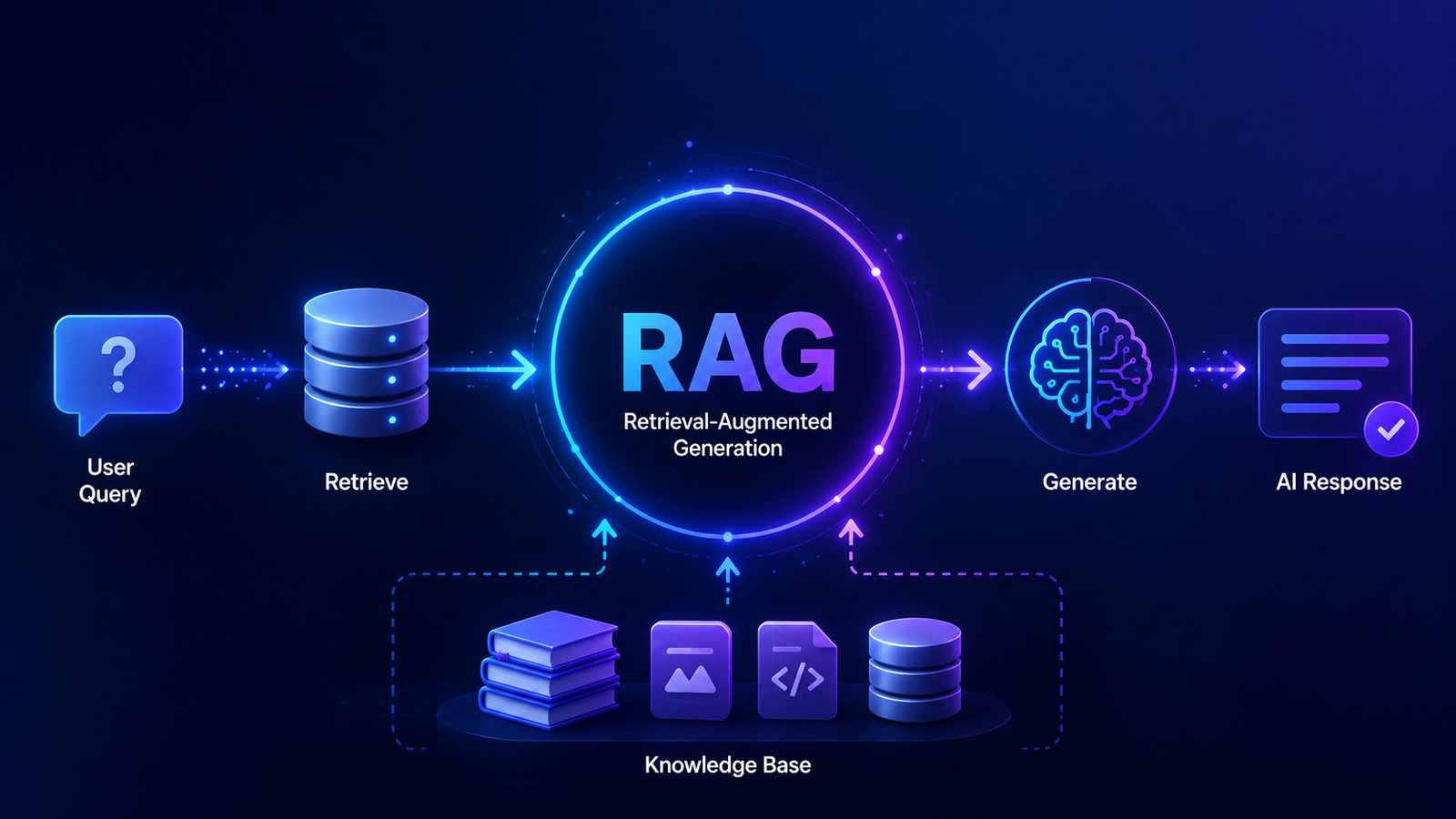
Instead of relying on what an LLM remembers, RAG retrieves trusted information before generating a response. The result is AI that’s more accurate, more relevant, and grounded in current data.
If you’ve been wondering what RAG is in AI, this guide explains it.
A common misconception is that AI “knows” everything. In reality, LLMs don’t search your company’s documents or browse the internet every time you ask a question. They generate responses based on patterns learned during training.
That’s why they can sometimes produce answers that sound convincing but are factually wrong. It’s a phenomenon known as hallucination.
There’s also the issue of a knowledge cutoff. If your company updated its policies, product documentation, or pricing after the model was trained, the AI won’t know those changes unless it’s given access to them during the conversation.
For many businesses, improving AI isn’t about using a bigger model. Rather, it’s about giving the model better information. As technologies evolve, this data-driven approach is also heavily influencing the AI future of Windows OS, where localized retrieval and smarter core processing are becoming standard.
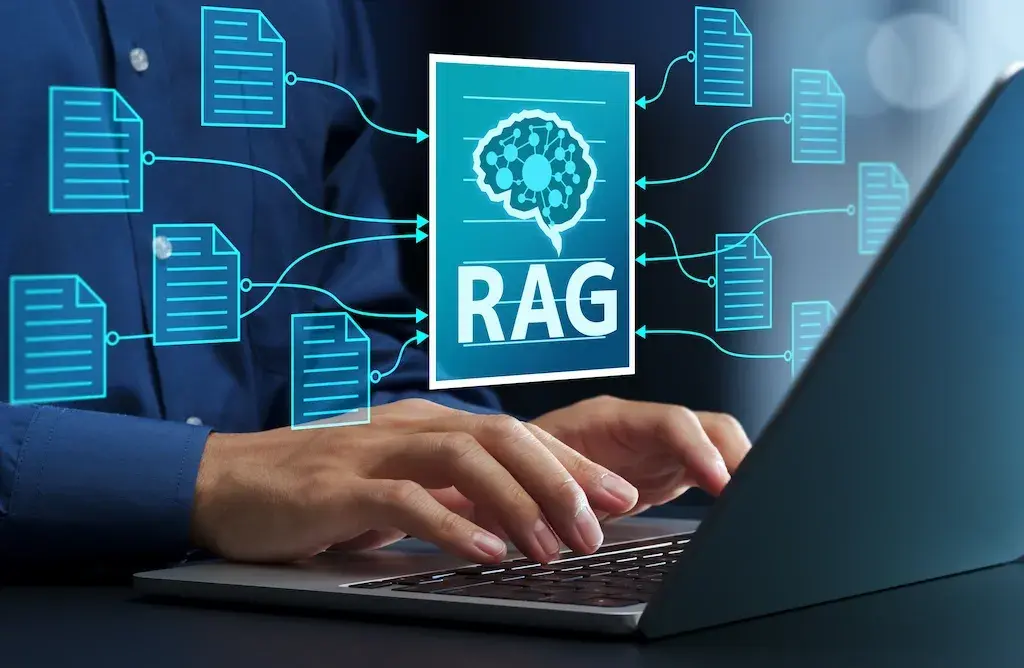
At its core, RAG in AI combines information retrieval with natural language generation. Instead of answering solely from memory, a RAG system first searches trusted sources such as:
It retrieves the most relevant information and passes it to the language model, which then generates a response based on those documents. Consider it like giving someone the correct pages from a textbook before asking them to answer a question. Naturally, the response is more accurate.
This is one of the most effective ways to improve AI model accuracywithout retraining the model.
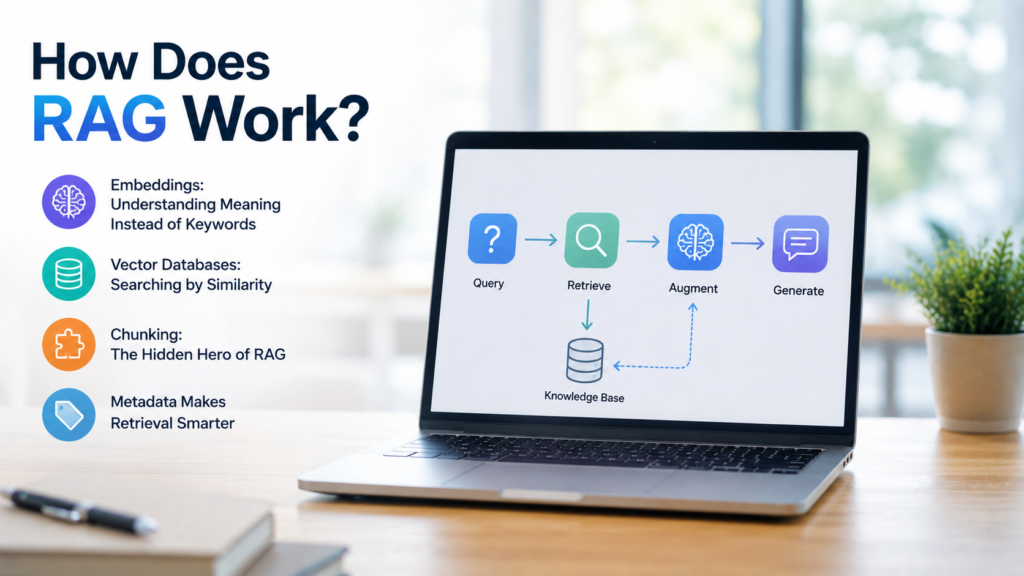
Although RAG sounds technical, the process is surprisingly straightforward.
The first step is converting your question into an embedding—a mathematical representation of its meaning.
Unlike keyword searches, embeddings understand context. For example, “vacation policy,” “annual leave,” and “paid time off” are recognized as closely related concepts even though they use different words.
This semantic understanding helps RAG find relevant information even when users phrase questions differently.
Once a query becomes an embedding, it searches a vector database rather than a traditional SQL database. Instead of looking for exact keyword matches, vector databases compare meanings to find the closest documents.
Popular options include Pinecone, Weaviate, Chroma, FAISS, and Milvus. The best vector database for RAQG depends on your application’s size, scalability requirements, and budget.
Business documents are often too large to retrieve efficiently, so they’re divided into smaller sections called chunks.
Good chunking strikes a balance:
Many production systems also use overlapping chunks to ensure important information isn’t accidentally split between sections.
Surprisingly, improving chunking often has a bigger impact than upgrading to a larger LLM.
Metadata acts like labels attached to every document. These labels might include publication date, department, region, product version, and document type.
Imagine an international company with separate HR policies for different countries. Metadata helps the retriever select the correct policy before generating an answer, making responses far more reliable.
The IR pipeline in a RAG architecture determines which information reaches the language model. A typical workflow looks like this:
This explains why many AI engineers say retrieval, not the language model is the true engine behind a successful RAG system.
Understanding this question is simple: it delivers more trustworthy answers while reducing maintenance.
Unlike fine-tuning, RAG separates the model from the knowledge base. When documents change, businesses simply update the source files instead of retraining the AI. This makes RAG especially valuable for industries where information changes frequently. Examples include:
Enterprises generally build on top of scalable, cloud-based frameworks or pre-trained foundation models to keep proprietary data secure. Some enterprise AI examples include:
Basic semantic search is only the beginning. Many production systems use additional retrieval techniques to improve performance.
| Retrieval Techniques | What It Does |
| Hybrid Search | Combines semantic search with keyword matching, making it ideal for finding exact product IDs, invoice numbers, or error codes. |
| Multi-Query Retriever in LangChain | Generates several variations of the same question before searching, increasing the chances of finding relevant documents. |
| Maximum Marginal Relevance (MMR) | Reduces duplicate results by selecting documents that are both relevant and diverse. |
| Contextual Compression | Removes unnecessary text before sending documents to the LLM, reducing token usage while keeping the important information |
| Parent Document Retrieval | Starts by finding a relevant chunk and then expands to the larger section for better context. |
If you’re looking for LLM model accuracy tips, focus on retrieval rather than the model alone. Some proven strategies include:
Many organizations discover that better documents improve results more than switching to a larger language model.
Improving AI starts with measuring it. Instead of relying only on user feedback, AI teams evaluate metrics such as:
According to Label Studio, frameworks like RAGAS, LangSmith, and DeepEval help benchmark these metrics and identify areas for improvement.
Understanding what RAG is in AI is the first step toward building more reliable AI systems.
The best RAG implementations aren’t defined by the biggest language model. They’re built on high-quality documents, thoughtful chunking, effective metadata, and a strong retrieval pipeline. If you want to improve your AI model’s accuracy, start with your knowledge base. Organize it well, keep it updated, and continuously evaluate how information is retrieved.
As enterprise AI continues to evolve, Retrieval-Augmented Generation is proving that smarter AI isn’t just about generating better text—it’s about connecting the right information to the right question at exactly the right time.
If you enjoy breaking down complex AI topics into practical insights, share your expertise with a wider audience. Send it to us at Tech: Write For Us.
Enterprise AI needs to be accurate and reliable. RAG (Retrieval-Augmented Generation) connects generic AI models directly to a company’s private, internal data. Instead of guessing or “hallucinating,” the AI fetches real-time, relevant facts from your business documents to answer questions safely, ensuring highly context-aware and factual insights.
Yes, RAG significantly reduces AI hallucinations. Instead of relying solely on static training data to guess an answer, RAG forces the AI to retrieve and look at specific, verified source documents first. It then grounds its response entirely in those real-time facts, preventing it from fabricating information.
Vector databases act as the efficient memory retrieval system for RAG.
Instead of storing data as plain text, they convert documents into numerical formulas called vector embeddings, which capture the actual meaning of the words. When a user asks a question, the vector database performs a fast similarity search to find and retrieve the most contextually relevant information, which is then fed to the AI model to generate an accurate response.
A Multi-Query Retriever automates prompt tuning by using an LLM to generate multiple variations of a user’s initial question from different perspectives.
Instead of running a single vector search, it runs searches for all the generated variations. By combining and deduplicating the retrieved documents, it overcomes the limitations of distance-based vector searches, capturing a richer and more complete set of relevant context.
Legal, healthcare, finance, and customer support benefit most. RAG allows them to securely query massive, rapidly changing internal data—like case law, patient histories, financial regulations, and technical manuals—ensuring highly accurate, compliant, and hallucination-free AI responses.

As a tech-savvy Digital Marketing Specialist at Digital Concepts for the past five years, Sushmita Banerjee bridges the gap between complex tech and impactful storytelling. She channels her expertise into writing thought-provoking content covering everything from AI and software to the latest gadgets and breakthrough tech trends.