You finally get your hands on that gaming console you’ve been eyeing for months. Your friend buys the exact model a little later. Both boxes promise the same specifications, but there’s a catch: the components inside might be non-identical.
Welcome to the world of console hardware revisions, where manufacturers quietly change internal parts without necessarily announcing every adjustment. These changes can affect storage capacity, power consumption, cooling, and even how much you pay for the same product.
Why is this happening? Chip shortages, rising component prices, and manufacturing challenges are pushing gaming companies to rethink how they build consoles. And if you love gaming hardware, there’s plenty to unpack here.
A modern gaming console is a small engineering marvel. It combines a processor, graphics hardware, memory, storage, and cooling components into a compact system. If one essential component becomes expensive or difficult to source, the entire production process can take a hit.
The problem isn’t limited to gaming. The growing demand for AI infrastructure has increased competition for memory chips, particularly DRAM used in consumer electronics and gaming devices.
A December 2025 Reuters report highlighted how data-centre demand was tightening memory supplies and pushing prices higher. The report cited estimates that memory prices had risen by around 50% during 2025, with further increases expected.
For console manufacturers, that’s a headache. They produce millions of devices, often work with tight hardware budgets, and cannot simply replace every component whenever prices change.
So, what can they do?
Not every change is caused by a shortage. Some are routine engineering improvements, while others may be cost-saving decisions. Manufacturers also rarely disclose the exact reason behind every revision.
Gaming console revisions have been around for years. However, recent examples show why checking the specifications on the box matters.
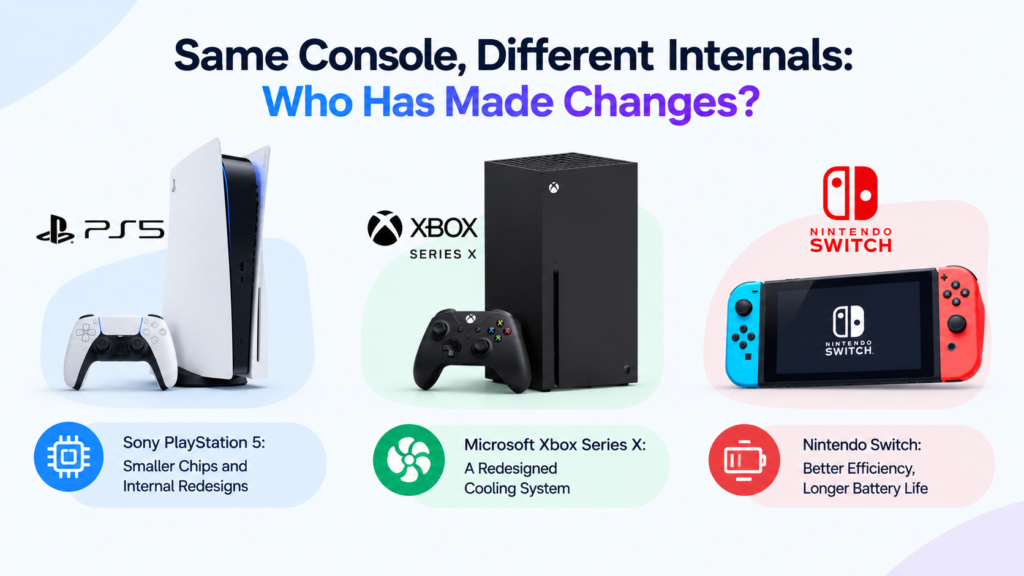
Sony has revised the PS5 several times since its launch in 2020. Some changes have involved the motherboard, heatsink, cooling assembly, and processor.
In 2022, the PS5’s CFI-1200 series attracted attention after a teardown revealed a significantly smaller motherboard and a lighter overall design. Technical analysis also identified a move to a more efficient 6nm processor.
PCMag’s report on the PS5’s hardware revisions explains how Sony altered the console’s internal layout. These changes helped reduce weight and power consumption without turning the console into a new performance tier.
More recently, another revision has raised eyebrows. According to Tom’s Hardware, Sony’s CFI-2116 PS5 Digital Edition appeared in European listings with an 825GB SSD instead of the 1TB drive found in the earlier version. The reported price remained the same.
That’s a reduction of 175GB in advertised storage, or 17.5%. If you regularly install large games, this difference matters. You might need to delete games more often or invest in an additional compatible SSD.
Sony hasn’t publicly confirmed that the storage change was caused by chip shortages. Still, it illustrates how a familiar product name doesn’t always guarantee identical specifications.
Microsoft’s Xbox Series X has also received internal hardware redesigns.
Teardowns of revised models revealed a smaller 6nm system-on-chip and changes to the motherboard and cooling arrangement. The revised design replaced the original vapor chamber with a conventional copper heat pipe.
Reporting from The Verge examined these Xbox hardware revisions and their potential effects on power consumption and manufacturing costs.
What does this even mean for you? A redesigned cooling system can change how heat moves through the console, while a more efficient chip can reduce electricity use. Neither change automatically translates into better graphics or higher frame rates.
It’s also important to distinguish internal revisions from different Xbox configurations. A digital-only console, for example, lacks a disc drive by design. That’s a product variation, not an undisclosed component swap.
Nintendo’s Switch offers another useful example of how internal changes can affect everyday gaming.
The original Switch launched in 2017. In 2019, Nintendo released a revised model with improved battery life, followed by the Switch OLED in 2021. These were identifiable versions, rather than entirely unannounced substitutions.
The improved battery life of the 2019 model was linked to changes in its internal hardware, including a more efficient processor. Nintendo’s official developer interview also discusses the engineering behind the system and its components.
For a handheld console, efficiency isn’t just a number on a specification sheet. It determines how long you can play before reaching for the charger. That’s a benefit you’ll notice much sooner than a minor change to the motherboard.
Not every internal change affects gameplay. Some are invisible during normal use, while others can make a noticeable difference.
| Hardware change | What it could mean for you |
| More efficient processor | Similar performance with lower power consumption |
| Smaller motherboard | Reduced weight or manufacturing costs |
| Redesigned cooling system | Different temperatures or fan noise |
| Smaller SSD | Less room for installed games |
| Different power supply | Changes in efficiency or internal layout |
| Revised supporting components | Potential differences in servicing or repair |
The key word is could. A smaller chip doesn’t automatically mean a faster console. A different fan doesn’t guarantee quieter operation, either.
Most manufacturers aim to preserve the same supported gaming experience across revisions. You should still be able to play the same compatible games, although the exact specifications may differ.
There can also be practical differences for repair technicians. A new motherboard layout might make one component easier to replace and another harder to access. These details matter if you plan to keep your console for years.
The term panel lottery usually refers to TVs and monitors, not gaming consoles. According to MakeUseOf, two displays sold under the same model name can sometimes use panels from different production batches or suppliers, resulting in variations in brightness, contrast, color uniformity, or response behaviour.
Why are we mentioning this? Since your gaming experience depends on more than the console itself. You could own two identical PS5 units but get a noticeably different visual experience if you’re using different displays.
A console’s internal revision and a display panel’s variation are separate issues. Neither guarantees a better or worse experience, but both explain why identical product names don’t always tell the whole story.
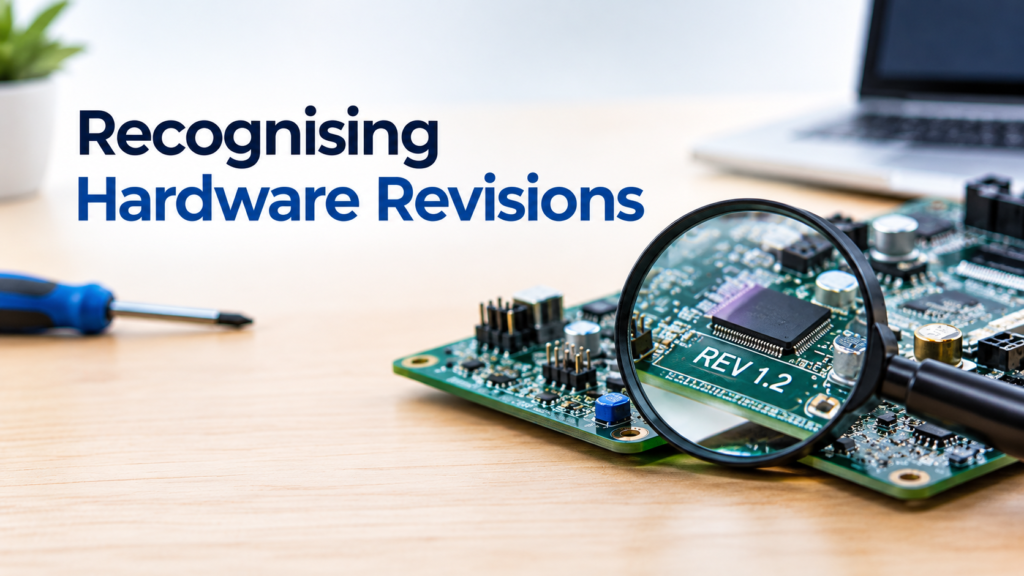
You don’t need to dismantle a console to start investigating. A few simple checks can help you identify differences before you buy.
One caution: a model number doesn’t always identify every motherboard revision. If you’re buying a used console, check its condition, warranty, repair history, and exact specifications rather than relying on the model name alone.
Silent hardware changes aren’t necessarily bad news. They can help manufacturers keep production running, reduce power consumption, and adapt to changing component costs. But they can also mean that a newer console isn’t automatically better than an older one.
Before buying, compare the actual specifications, particularly storage capacity, and look for reliable reports about internal changes. If you’re choosing between two versions at the same price, those details could matter more than the release date.
After all, you’re buying a gaming experience, not just a familiar logo on a box. If you want to follow more Latest Tech Updates and Trending Tech News, follow us. And if you want to share your own thoughts, send them to Tech: Write For Us.
The shortage is mainly triggered by a massive surge in AI data center demand, alongside supply chain bottlenecks and factories shifting production toward high-end components.
Rapid AI infrastructure expansion is soaking up a huge portion of global memory production, leaving fewer resources for everyday consumer electronics.
Industry analysts expect tight supply and high prices to persist through 2026 and potentially stretch into 2027.
Yes, manufacturers frequently release silent revisions (such as smaller motherboards or updated cooling systems) over a console’s lifespan.
Yes, Sony has used physically different chips across hardware revisions (like the Slim models) or minor variations from manufacturing silicon sorting, though overall gameplay performance remains identical.

As a tech-savvy Digital Marketing Specialist at Digital Concepts for the past five years, Sushmita Banerjee bridges the gap between complex tech and impactful storytelling. She channels her expertise into writing thought-provoking content covering everything from AI and software to the latest gadgets and breakthrough tech trends.
 How Big Tech Companies Are Managing AI Risks and Whether It’s Enough
 How Silent Hardware Changes Are Changing the Gaming Experience
 From Screen to Share: Best Recording Software for Windows & Mac
 AI Robots for Home Use: Transforming Everyday Living With Smart Technology
 AI Tools to Track AI-Generated Content